
Olena Skachko
Anastasiya Melnychenko: Imposter syndrome, loss of professional identity, and rebuilding coping mechanisms in forced migration
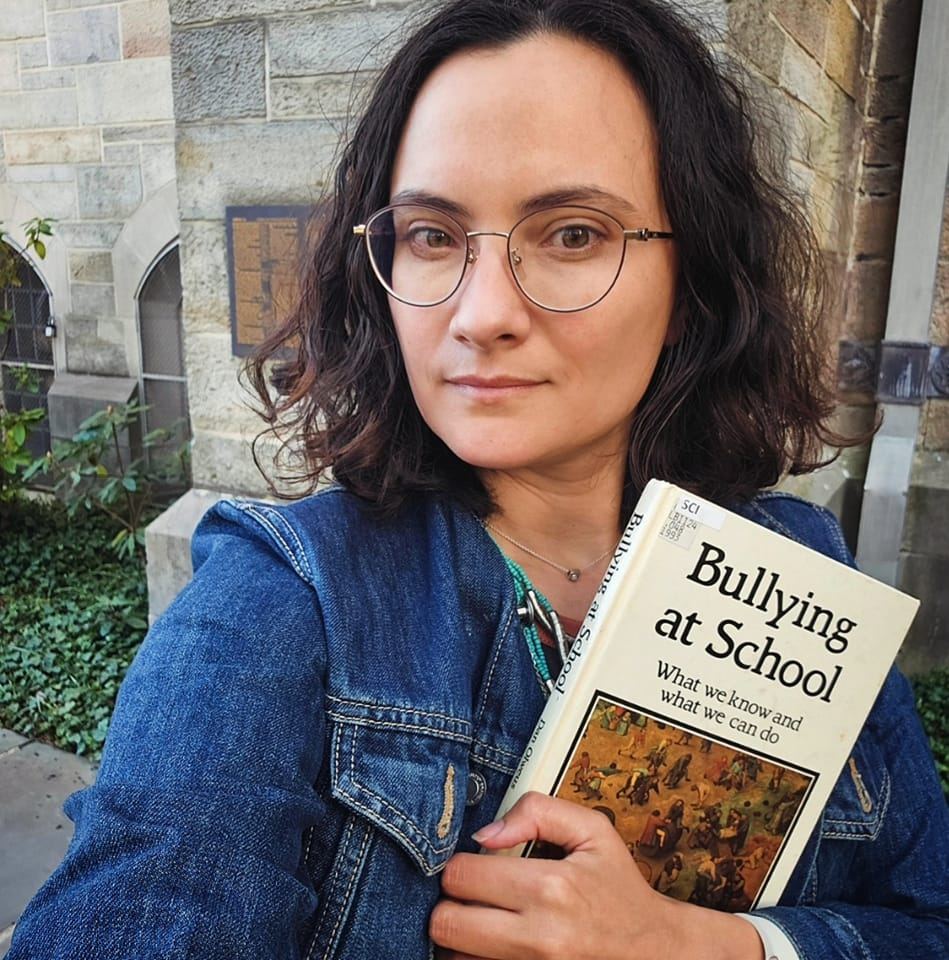
Ukrainian writer and public figure Anastasiya Melnychenko was relatively lucky to find a doctoral researcher position and settle in Finland after being forcibly displaced in 2022.
But while working on her dissertation at the University of Turku with a grant for the next two years, she found herself asking: “What’s wrong with me? Why, while doing something I could only dream of as a forced migrant, in a wonderful and safe country, with my family by my side and some degree of financial predictability until 2027, do I feel so awful?”
Anastasiya had had a good life in Ukraine: a job she loved, a stable income, and a house she had bought just a year before the invasion. With children, dogs, a husband, and their private home in Irpin, everything felt harmonious. It was warm and good.
“I was a journalist and a public activist. My life was filled with events while also having a tangible social impact. I was the head of the non-governmental organisation ‘Studena’ and had begun studying bullying. I was not a researcher in the full sense, but rather I was accumulating knowledge and expertise back then.”
Anastasiya became a Fulbright scholar at the University of Denver, but her stay in the US had to be abruptly interrupted by the full-scale invasion. She had to ensure her children's safety. Until the very last moment, the children’s father did not believe anything serious could happen. In the end, the children remained with him in Ukraine.
After the full-scale invasion began, Anastasiya applied for the Scholars at Risk programme at Princeton University, where she spent two years as a visiting researcher. In the final days of her stay in the United States, she realised that delving deeper into the topic of bullying would be possible in a place where the subject is studied intensively. “I chose the University of Turku in Finland, where one of the strongest research groups in this field works. I found a grant for Ukrainian researchers and applied.”
‘Social death’ in immigration
“The realisation that something was wrong began at the start of the invasion. I lost the ability to function normally. My coping strategies were based on small routines. When they disappeared, everything fell apart.”
Having once had an established life, where her research recommendations could be implemented at a systemic level, at 42, she became a student again.
“I had a very difficult time accepting my new status in Finland. I came from the public sector and found myself in an academic environment without a sufficient base. Being connected to the Finnish academy, I still do not fully understand the rules and social norms, and I feel like an impostor claiming an uncharacteristic role. But at the same time, I have to be an adult who is expected to know and be competent in everything.”
At Princeton, she tried to understand the system: taking courses, mastering research methods, and often following the principle of “fake it until you make it.”
“Starting from scratch has given me strong imposter syndrome. From the outside, I look like a high-class professional with vast work experience, knowledge, and expertise, but inside, there are constant thoughts about how many gaps I might still have. Although objectively I have grown significantly, I am constantly accompanied by the fear of ‘exposure’.”
Her thesis focuses on bullying, particularly on how propaganda of discord affects teachers’ reactions to bullying, combining the intersection of propaganda, polarising narratives, and their impact on education workers.
“Immigration and adaptation to a new role, as well as to new social norms, have created a status gap between who I was, who I identify with, and who I am now.”
Forced migration not only uprooted Anastasiya geographically; it dismantled the professional identity and social status that once filled her sense of self.
“In Ukraine, I had a voice as an activist and writer. I provided statistics to the Ministry of Education and Science, I conducted trainings… Now, at 42, I find myself in the status of a student in every sense: language, academia, mentality. I feel like I am constantly being evaluated, and for me, it has turned out to be very difficult. Perhaps the most challenging part of this path is invisibility. People are not willing to know me; they do not need to. Of course, how can I show my social value if my expertise has remained in Ukraine? And who am I here? A beginner researcher?”
What experts say?
What Anastasiya describes is not unusual, psychologists say. When neither fight nor flight is possible in response to a stressful situation, the nervous system activates an evolutionary protective mechanism: immobilisation. The body shuts down to reduce the pain of potential “death”, which in Anastasiya’s case, is a form of social demise.
According to Stephen Porges’ Polyvagal theory, “functional freezing” is a classic dorsal vagal response triggered by sudden or overwhelming environmental changes; immigration can be one of them.
Immobilisation, though rarely discussed, is often perceived as laziness or depression, whereas it is in fact a common survival reaction of the human body under extreme stress.
“The key factor here is the status gap and the loss of professional identity. The transition from having a voice, influence, and visibility to becoming ‘a student at 42’ is one of the most painful aspects of forced migration,” comments Iryna Sachenko, a psychologist and member of the British Association for Counselling and Psychotherapy.
This effect is commonly seen in other migrants as well. Ezenwa Olumba, a doctoral researcher at the University of London, describes it as “mental homelessness.” Reflecting on his migration from Nigeria to London, he has written about its negative impact on daily functioning and mental health. When physically remaining in the old location is no longer possible, the mind often migrates to the past, to familiar surroundings and supportive environments.
“I seem able to move around, attend university, walk the dogs, but higher-order cognitive functions — creativity, planning, creative writing, understanding deep concepts are blocked. It’s like I’m not in my own body,” Anastasiya says sadly.
Social status is one of the key indicators of self-worth and a marker of social value within society. According to Edward Deci and Richard Ryan’s Self-determination theory, people have three basic needs: autonomy, competence, and connection with others. “Accepting refugee status is a deep wound. It is an identity crisis; some people experience it as humiliation. The response is either shame: ‘something is wrong with me’ or idealisation of the past: ‘there I was someone, here I am nobody.’ At the neurobiological level, losing social status triggers the same brain regions involved in physical pain, the anterior cingulate cortex. Constantly living in such conditions increases cortisol, creating the risk that the stress response becomes chronic. Among Ukrainians who were fully established back home, status incongruence can activate a narcissistic trauma, where the image of the competent and self-realised self becomes non-existent in the new environment,” continues Iryna.
The psychologist adds that the rituals of grieving the loss of a career are neither normalised by society nor by the person themselves. "Therefore, working with displaced people must necessarily include legitimising this grief.”
In an environment where there is no status evaluation, the nervous system’s protective response can gradually lift. But the return to normal functioning should be prioritised by getting back into the “window of tolerance,” according to Porges’ theory. At times, simple co-regulation practices, such as safe contact with another person, may work better than talk therapy, experts say.
“It is difficult to define who I am now. Founding a civic organisation here helped me return to a familiar environment where I feel more confident. But at some point, I realised I felt like I was sixteen — as if I had returned to a state somewhere between a traumatised teenager and an unformed professional. It is a very strange feeling to find myself re-entering hierarchy from the bottom.”